Specialized Drive Controls for Power Chairs: A Simple Guide
Key Takeaways
- Customized Navigation: Specialized drive controls provide an alternative for individuals with limited hand function, tremors, or conditions like ALS and spinal cord injuries who cannot use a standard joystick.
- Control Languages: Devices are categorized as Proportional (speed varies by pressure) or Non-Proportional (operates on simple “On/Off” switch commands).
- Diverse Interfaces: Mobility can be controlled through various access points, including Chin Controls, Head Array Systems (using headrest sensors), Sip-and-Puff (using breath), or highly sensitive Mini-Joysticks.
- Clinical Requirements: Obtaining these systems requires a “Drive Evaluation” by an Assistive Technology Professional (ATP) to identify the user’s most reliable movement point.
- Insurance Pathway: Medicare approved power chairs in the “Complex Rehab” category (Group 3) often include coverage for these specialized interfaces when a standard joystick is proven ineffective.
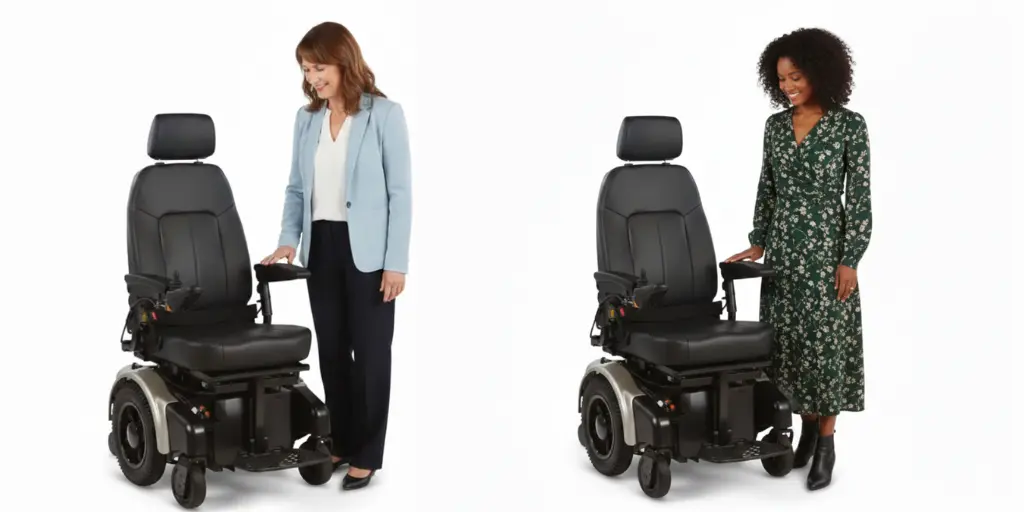
While most users interact with their mobility equipment using a standard joystick, many individuals require more tailored solutions to navigate their environment. For those with limited hand function, tremors, or neuromuscular conditions (such as ALS or spinal cord injuries), specialized drive controls are the key to operating heavy duty power chair safely and effectively.
Below is a guide to the different types of alternative drive controls available on Complex Rehab (Group 3) powerchairs and how they help users maintain independence.
Proportional vs. Non-Proportional Controls
Before choosing a device, it is important to understand the two main “languages” these controllers speak.
- Proportional Controls: These work like a gas pedal—the harder you push, the faster you go. These provide the smoothest driving experience.
- Non-Proportional (Switch) Controls: These operate on simple “On/Off” commands. One switch might mean “Go Forward,” and another means “Turn Right.”
Common Types of Specialized Controls
A) Chin Control (Proportional) – For users who have limited hand function but retain good head and neck movement, a chin control is often the first alternative explored.
- How it works: A compact joystick is mounted on a swing-away boom near the chin or mouth. The user manipulates the joystick using their chin movement.
- Best For: Individuals who need the smooth speed control of a standard joystick but cannot use their hands.
B) Head Array Systems (Non-Proportional) – A head array looks like a standard three-pad headrest, but it is actually a sophisticated driving system.
- How it works: Embedded sensors inside the pads detect pressure. Leaning your head back might stop the chair, while leaning left turns the chair left.
- Best For: Users with ALS or high-level spinal cord injuries who have reliable head control but cannot use a chin joystick.
C) Sip-and-Puff Systems (Non-Proportional) – This is one of the most well-known interfaces for high-level quadriplegia.
How it works: The user inhales (“sip”) or exhales (“puff”) into a straw-like tube to send commands. A “hard sip” might mean forward, while a “soft puff” might mean turn right.
Best For: Individuals with very limited movement below the neck who rely on breath control for mobility.
D) Mini-Joysticks and Finger Controls – Sometimes a standard joystick is just too heavy to push.
- How it works: These are highly sensitive, smaller joysticks that can be mounted anywhere—on a tray, near a finger, or even by a foot. They require a fraction of the force needed for a standard controller.
- Best For: Users with muscular dystrophy or fatigue issues who still have some fine motor control.
The Role of the ATP Evaluation
Because these systems are complex, they require a specialized evaluation by an Assistive Technology Professional (ATP). During this “Drive Evaluation,” the ATP will test different sensors to find your most reliable “access point” (the part of your body you can move most consistently).
To learn more about how advanced seating systems can improve your health, check out our guide on The Benefits of Power Tilt and Recline for Pressure Relief.
Medicare Coverage & Eligibility
Medicare approved Power Wheelchairs in the “Complex Rehab” category (Group 3) often include coverage for these specialized interfaces when a standard joystick is proven ineffective.
See If You Qualify – Do you or a loved one struggle with a standard joystick? Reach out today to speak with our mobility specialists. We can help you navigate the process for obtaining a system tailored to your unique needs.
FAQ: Specialized Drive Controls
Q1: What is the difference between proportional and non-proportional controls?
A: Proportional controls work like a gas pedal where the harder you push, the faster the chair goes, providing a smooth experience. Non-proportional (switch) controls operate on simple “On/Off” commands, where a specific switch activation triggers a pre-set movement like “Go Forward” or “Turn Right.”
Q2: How does a Head Array system work?
A: A head array uses sensors embedded inside a three-pad headrest. It detects pressure from the user’s head; for example, leaning the head back might stop the chair, while leaning left turns the chair in that direction.
Q3: Who should consider a Sip-and-Puff system?
A: This system is best for individuals with very limited movement below the neck. The user controls the chair by inhaling (“sip”) or exhaling (“puff”) into a straw-like tube to send different driving commands.
Q4: What if a standard joystick is just too heavy for me to push?
A: Mini-joysticks or finger controls are available for those with some fine motor control but limited strength. These are highly sensitive and require only a fraction of the force needed for a standard controller.
Q5: How do I qualify for these specialized controls through insurance?
A: You must undergo a “Drive Evaluation” by an Assistive Technology Professional (ATP) to find your most reliable access point. Medicare approved power chairs in the Complex Rehab (Group 3) category typically cover these interfaces if a standard joystick is proven ineffective for your needs.